
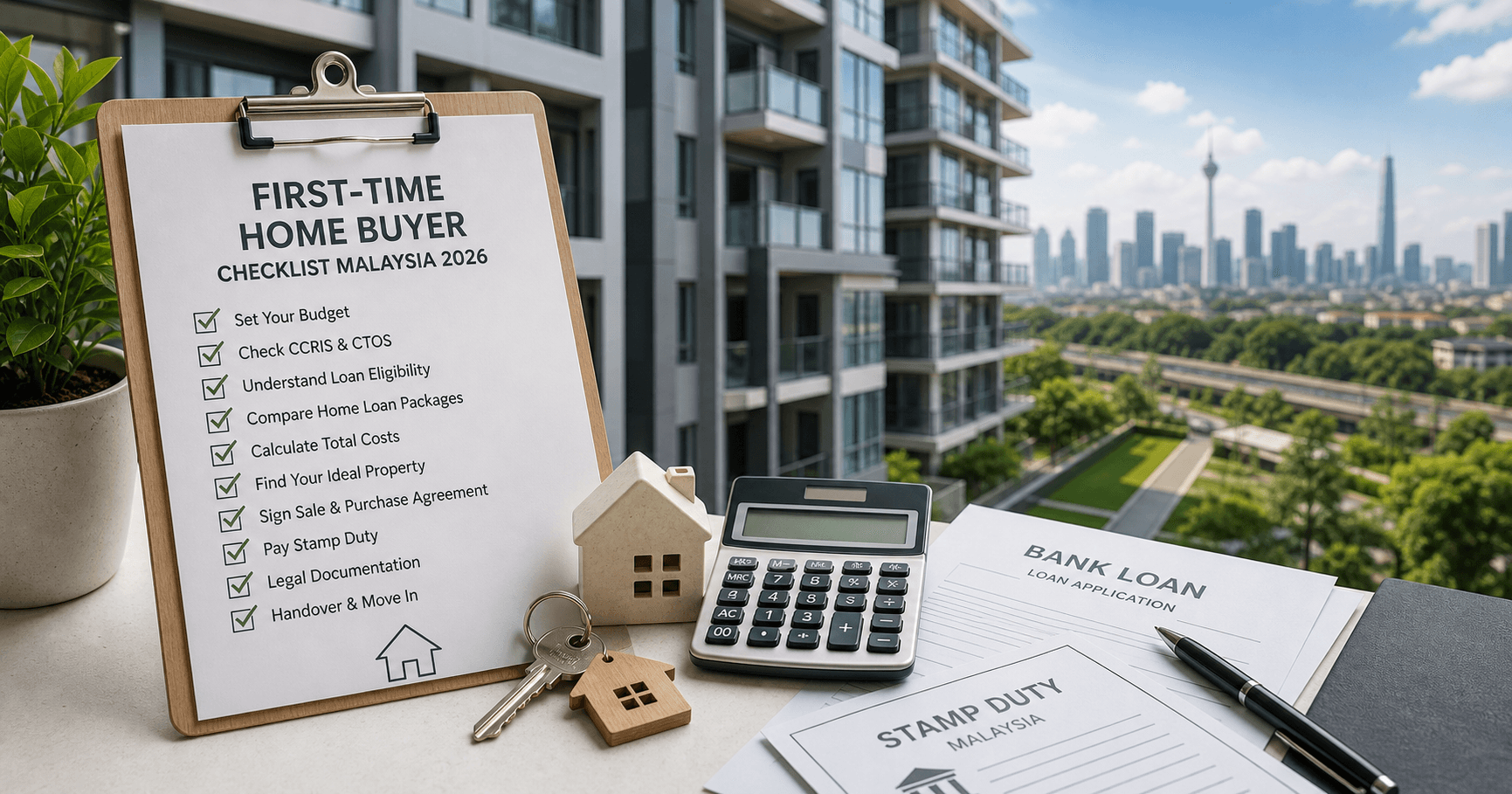
First-Time Home Buyer Checklist Malaysia 2026: Stamp Duty, Loan Readiness, and Market Timing
Buying your first home in Malaysia in 2026 is not just about finding a unit you like. It is about checking whether the numbers, legal steps, and timing still make sense before you pay a booking fee or sign the sale and purchase agreement.
This checklist is written for Malaysians buying their first residential property, especially homes priced around RM500,000 and below where the Budget 2026 stamp duty extension may matter most.
What changed for first-time buyers in 2026?
Under Malaysia's Budget 2026 tax measures, the 100% stamp duty exemption for first residential homes priced up to RM500,000 has been extended for another two years. The extension applies to sale and purchase agreements executed from 1 January 2026 to 31 December 2027.
For eligible buyers, this can reduce upfront purchase costs because the exemption covers the instrument of transfer and the loan agreement. The important point is timing: eligibility is linked to the SPA execution date, not just when you started viewing houses.
Who should use this checklist?
Use it if you are buying your first home for own stay, comparing affordable housing schemes, or deciding whether to buy a subsale unit or new launch in 2026. It is also useful if your parents, partner, or agent are helping you, because it gives everyone the same questions to work through.
Step 1: Confirm first-home eligibility before you shop seriously
Start with the basics. Are you a Malaysian citizen? Have you ever owned a residential property in Malaysia, including a freehold, leasehold, strata, or landed property? Is the target property priced at RM500,000 or below if you want to rely on the full stamp duty exemption?
Do not assume eligibility based on income alone. Ask your lawyer or banker to check the latest exemption requirements and documents before you commit, especially if the purchase involves joint names, inheritance history, or a spouse who has owned property before.
Step 2: Build a complete upfront-cost budget
Many buyers budget only for the down payment. A more realistic first-home budget includes booking fee, balance down payment, legal fees, valuation fee, loan documentation, MRTA or MLTA if required, moving costs, renovation, basic furniture, utility deposits, and maintenance charges.
Even when stamp duty is exempt, cash flow can still feel tight. Keep a separate emergency reserve after completion. A home that uses every ringgit of savings can become stressful the moment repairs, job changes, or delayed vacant possession enter the picture.
Step 3: Check loan readiness before viewing expensive units
Before shortlisting homes, calculate your debt service ratio and review CCRIS/CTOS records. If you want a deeper walkthrough, read PropGo's DSR home loan eligibility guide before speaking to banks. Banks look at existing commitments such as car loans, credit cards, personal loans, PTPTN, and other financing. A clean repayment record and realistic instalment target matter more than an optimistic asking price.
A simple rule: if the monthly instalment plus maintenance fees would make you uncomfortable for six months during an income shock, the unit may be too aggressive for your first purchase.
Step 4: Compare new launch, subsale, and affordable schemes
New launches may offer rebates, developer packages, and staged payments, but buyers should check completion risk, actual net price, and whether incentives hide a high base price. Subsale homes give you a real neighbourhood and visible defects, but usually require faster cash preparation.
Affordable housing schemes can be valuable, yet they may include moratorium rules, resale restrictions, income criteria, or location trade-offs. Read those conditions as carefully as the price tag.
Step 5: Use current market data before making an offer
Do not rely only on asking prices. NAPIC's 2026 publications include Q1 2026 transaction tables, residential price tables, stock tables, market status tables, and the Malaysian House Price Index. These data points help you compare the seller's price with actual market evidence.
For subsale homes, compare recent transactions for the same project or nearby landed area. For new launches, compare the net price per square foot with completed alternatives nearby. If the gap is large, ask what justifies it: better location, newer facilities, lower maintenance risk, or simply marketing.
Step 6: Inspect legal and building risks early
For strata homes, check maintenance fees, sinking fund, JMB or MC condition, defects, parking allocation, and house rules. For landed homes, check title type, renovation approvals, boundary issues, road access, and flood history.
Before signing an SPA, ask your lawyer to explain key clauses, completion timeline, late-payment consequences, vacant possession terms, and what happens if financing is delayed. First-time buyers should never sign legal documents they only half understand.
Step 7: Decide whether 2026 is the right time for you
The best timing is not the same for every buyer. A stable job, clean credit profile, realistic price, and good property fit matter more than trying to catch the perfect market bottom. If the numbers work after stress-testing, 2026 can be a sensible year to buy because the stamp duty extension gives eligible first-home buyers more breathing room.
If the numbers do not work, waiting is also a strategy. Use the time to reduce debt, build savings, monitor NAPIC transaction evidence, and improve loan eligibility.
First-time buyer quick checklist
Confirm you have never owned a residential property in Malaysia.
Check whether the property price is RM500,000 or below for the full first-home stamp duty exemption.
Get a bank pre-check before paying a booking fee.
Prepare cash for legal, valuation, moving, renovation, and emergency costs.
Compare asking prices against recent transaction data.
Inspect title, strata, defects, maintenance, and neighbourhood risks.
Read the SPA and loan documents with your lawyer before signing.
Keep at least three to six months of essential expenses after completion.
FAQ
Does every first-time buyer get the 2026 stamp duty exemption?
No. The Budget 2026 measure is for Malaysian citizens purchasing a first residential home priced up to RM500,000, with the effective period tied to SPAs executed from 1 January 2026 to 31 December 2027. Always confirm your exact case with your lawyer or tax adviser.
Should I buy a new launch or subsale for my first home?
Choose based on affordability, certainty, and lifestyle fit. New launches may reduce short-term cash pressure, while subsale homes let you inspect the real unit, management quality, and neighbourhood before committing.
How much cash should I keep after buying my first home?
Aim to keep at least three to six months of essential expenses after completion. Home ownership brings irregular costs, and first-time buyers often underestimate repairs, furnishing, and moving expenses.
Sources: Ministry of Finance Budget 2026 Tax Measures; NAPIC Latest Publications Q1 2026.